

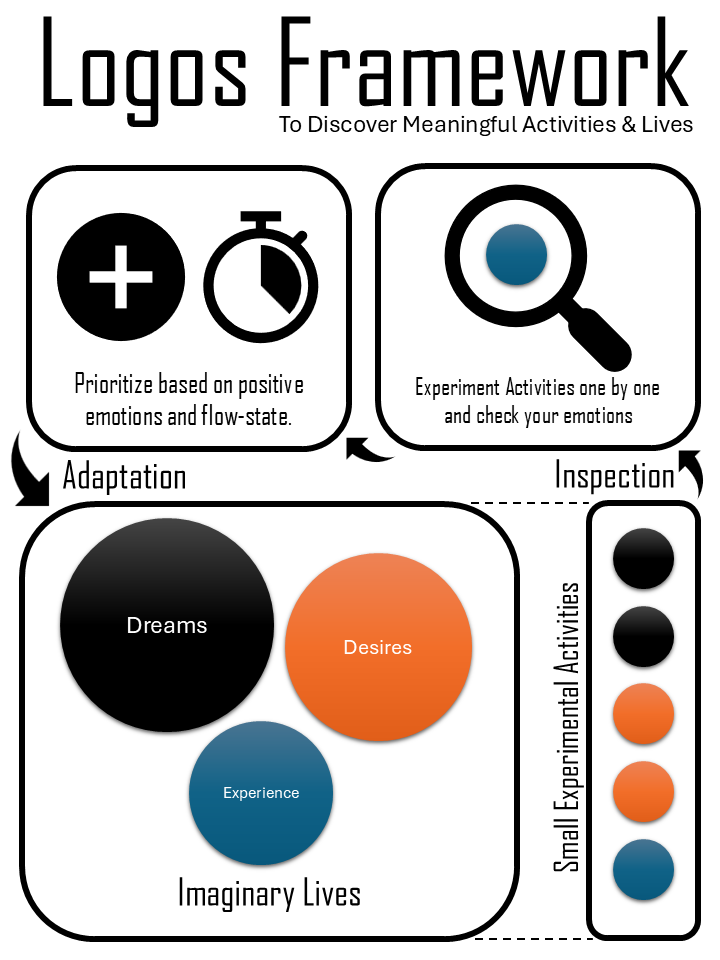
What is the Logos framework?
English Version
I have looked for the meaning of my life, or even human life, since I was in high school. But I haven’t found a practical method except one designed by Viktor Frankl. When I was reviewing his work, I understood that finding life’s meaning is not as simple as I had imagined. Suddenly, one idea popped into my mind; and I am a Scrum Master, and Scrum helps solve complex problems. Would it be possible to discover meaning by using Scrum? This question led me to design this framework. I named it Logos. Because Logos means “meaning,” and this is a framework that helps you discover activities that matter to you. I can’t believe these activities are limited because I have enjoyed totally different activities for many years like solving math and physics problems, graphic designing, hosting, hiking, playing video games, podcasting, coaching, etc. As you can see, it is unlimited. I am sure it is also valid for most of you. Then we can always use this framework to find meaningful activities. Let’s dive into the Logos framework.
The purpose of the Logos framework is to help humans discover and find their meaningful activities and imaginary lives. There are two parts in the framework.
Discover Meaningful Activities
Choose & Live Imaginary Lives
Discover Meaningful Activities
What are meaningful activities? As I said, I was inspired by Viktor Frankl. To know what they mean, you can read this page. The first part of my framework is about how to find meaningful activities. This part has 5 steps.
Imagination: Think and write about your imaginary lives. Your dreams, desires, and experiences can help you to imagine them. What are you doing there? You must be happy in your imagination. But it might be different in reality. That’s why Steps 2 and 3 exist.
List Small Activities: Here you need to list activities that align with each imaginary life. We are going to experiment with each to validate our imaginary lives.
Experiment: You need to do each activity and inspect:
If your emotion is positive when you did the activity.
If you were in flow or time flew for you.
Prioritize: Prioritize activities like this:
First Priority: Those activities that had positive emotions and flow for you. These activities
Second Priority: Those activities that brought positive emotions for you without experiencing flow state.
Third Priority: Those activities that are not matched with prior priorities.
Adapt Imaginary Lives:
First Priority activities support your imaginary lives. Keep them and design new activities to increase your confidence.
Imaginary Lives that have Second Priority activities need more activities to ensure if they can put you in a flow-state.
Third Priority activities attack their imaginary lives. They try to tell you they are not as enjoyable and satisfying as you imagined and they don’t put you in a state that time flies for you.
Repeat.
Choose & Live Imaginary Lives
When you try many small activities, you can recognize which imaginary live is best for you. When you feel confidence about one of them, increase your focus on it and live that imaginary live more. Remember you are not oligated to continue them forever. That’s why commitment is meaningless. But you probably want to reach a goal, a state in the future that you want to achieve but you are not there already. In this way, you have to be committed to it. Because if you leave it, you won’t achieve that state. You already have First Priority activities and you can also organize them toward a goal. In this way, you will maximize positive emotions and flow in your life.
For example, when I started my podcast, Agile Gap, activities like hosting, graphic designing, and Scrum Mastery came together and that was fantastic for me. It happened unconsciously but it was exactly what I wanted.
I hope it is helpful for you. Please provide your feedback if you try the framework. Your feedback is very valuable for me because it helps me improve it.